blogalog

Monday, January 31, 2011

My Boys Sure Take Some Beating!


Last Monday was very strange for me — unnerving and sad. It was the fourth and the final day of Pongal. Pongal is the South Indian Harvest Festival; it’s a late English August held on the 14th of January. Christmas here is usually a vague awareness that something might be going on, and if you have a name like John, some body or other will doubtless send a wave or holler a call of Merry Christmas, more likely in hopes of getting a present than a concern over whether your enjoying your own festival. Christmas is dwarfed because we’re getting ready for the New Year (the western one) and that’s dwarfed by the prospect of Pongal.
There are 12 days of Christmas, but only four days of Pongal: and on the fourth day of Pongal, the wise keep a low profile; their heads are kept down low, their eyes cast down to the ground, or on the bed with sheets pulled up to chins; on the fourth day of Pongal you stay indoors, or you creep into your garden cautiously and you don’t go outside your compound wall.
On the fourth day of Pongal, the ghosts of Old India rise up as the clock is wound back 30 years or more. In that time ‘we’ are the lords of the fiefdom, and ‛they’ are outcastes from the colony sector, who come to work in our fields and enter our boundaries, hands out-stretched in supplication. Old folks on their death-beds rise up from their final agues, hands stretched forth in hope of a bag of rice, not to nourish their skeletal bodies for now, but to nourish their souls for later on. My spine tingles. This can’t be happening.

The Present—Past Tense
Someone drops the lid of a saucepan. The clang shocks me out of my brown study. This isn’t the mid ’70’s — it’s Monday 17th January 2011, for Heaven’s Sake. The Old India has gone, and gone for good. The New India has arrived, the India that powers the software that runs British Gas. These days, India is everywhere, not just here. You know: the India where in the Home Counties I stub my toe on a sharp stone in the garden and curse because the street light’s bust. In a fit of pique I pick up the phone to dial the Council. I’m answered by a pleasant young man. He thinks I think he’s local, so I exploit his illusions and play with him for a bit. He wonders how I appear to know so much about him, little suspecting that his call centre language training hasn’t ironed out all the creases in his accent. I pick up the wrinkles in his speech envelope, because I specialise in the pieces that other people miss. I already know his Indian PIN code from the dialect twang, and I tell him my UK postal code and the number of my house. He apologizes profusely for the neglect ‛our’ local council has shown me, and promises that he’ll send a van round the following day. He asks if there’s anything else he can do for me, and I sigh down the wire, giving him a benediction in the Tamil Tongue as I disconnect the line. Perhaps he’s now wondering who is who and whether he’s awake or sleeping. I muse about him too, finding I’m wracked with a twinge of guilt, because I moaned about a street light, but I do have other lights in my village street. If the call-centre man is lucky enough to have a street-light, he’ll be even luckier if it’s working.

Snap Out of It!
Now I must attend; I must wake up from the dream within my reverie. I’m not sure which dream was which, but the one I’ve woken into now sounds urgent: There are shouts and calls and shrill reedy whistles as fingers are stuck in mouths. My Devaraj, normally so attentive, is only half ‘there’; mobile phones chirrup, and motorbikes are revving. ‟Sorry anbey” he says, putting on his coat, “There’s trouble” and he’s half out the door... I’m seized with panic as my dream cruelly collapses. This is like being left back at the hospital again, your mother going away and leaving you. I look pleadingly at him but he says he has to leave, and he’s left an uncle to see over me. My final plea is that of course he must go, but please at least tell me what all this is about, and it’s here that he takes a short pause and sits down to tell me the tale.

I Must Take the Beating

There’s been a bit of trouble, dear, he explains. A friend was involved in a motor-cycle accident and Barney went to help. It was in Anna Purna, a village which contains factions which rival ours; things were taken amiss and someone in a state of intoxicated insobriety called the Police. (The bastards, I think. The bastards called out bigger Bastards, who horned in to join in the fray. And the bigger Bastards’ policy is: take money first and beat the other side. Make an arrest for disrupting the peace, then take the culprits down to the Police Station for a further beating. There’s usually a big brutish bloke in there. They pick him out for his size and put a uniform on him and give a piece of rubber to beat people with.)

That’s what they’ve done with Barney. After the first beating, they’ve taken him down to the station for a further, harsher beating. I have to go to help. If they keep on beating him, they’ll end up making out an FIR, a First Incident Report. Once that’s done there’ll be no turning back. There’ll be a Court Case which will take months and months; his passport will be impounded, and he won’t be able to accompany you to England.

I have to go. I’ve got a different T-shirt to the one my brother’s wearing. While they’re taking a breather between beatings, we’ll switch shirts. Then when they see me with his top on, they’ll think he’s me, and I am he. So goodbye, my love, I’ll go and take what comes to me. Don’t worry —I’ll be back. Two or three hours, or perhaps a little sooner. I’ll be back.

Going to help out a mate in trouble is standard practice here, but it’s not just social politeness. It’s really vital. Helping out a friend is part of the survival mechanism. My tender carer, whose soft hands know every inch of my delicate frame, is going to swop places with his brother. He’s cheerfully going to submit to the pain, to let the Police beat him with fists, with sticks, and perhaps a rubber hose. And after that, he’s planning to return, and take his place along my side for the remainder of the night.

* * * * *

For a moment I wonder why the cicadas sound so shrill tonight, but then I know that the singing in my ears is just the sound of being stunned. I recall a recent commuication we received a week or so back: Barney’s Visa restrictions have now been lifted and he is free, should he so desire it, to apply for membership as a Reserve Policeman.

Laying Down His Life...


Tuesday, January 18, 2011

The Two Tonys [i]

The Tonys were home-makers, and their kitchen turned out wonders.  Grisly wonders, on this occasion, laced with blood — pâtés and terrines.  I nibbled awkwardly at some crisp sheets of Melba toast, to show willing.” — From The Novel Cedilla by Adam Mars-Jones ('literary sadist') to be published on Thursday 20th January, 2011.

It's funny how the wheels turn. The last time I had two Tonys for company was 1972; they’d mince along in my direction before perching on the sofa next to me (keeping a wary distance) before to me and saying things like: “What have you been doing today?” or “We didn’t see you last week... hope things were OK” or “Tony managed to procure some Gjetost yesterday. We had to go to Robert Sayle to buy a stainless steel cheese slicer at a shocking price. We bought brown Rye-King and Cashew-Nutta from the health shop in Rose Crescent and found it perfect as a base on which we could lay the slivers, and cutting it in itself is quite a business. Anyway, the first thing Tony said was, ‘Make sure we save a slice for Little John, who can’t get any’ — Didn’t we, Tony?” and I was handed a brown crispbread smeared with brown goo and a sliver of some fudge-like substance balanced on the top. I was starving but I asked him if he’d he’d put it on the counter for me to take later. I couldn’t stand the idea of the expectant looks I’d get from them, eagerly awaiting my comment on the strange cheese, knowing full well that they’d have no interest whatever in my thoughts which they’d merely use as a springboard to launch into their chic opinions and judgments. I hate listening to people’s judgments on food I haven’t tried, and I hate listening to opinions of dishes I haven’t eaten when they’re prequelled with details of the ingredients you’ll need, methods of preparation and cooking. You’re just supposed to enjoy the dish first. You’re supposed to be enamoured with it so much that you end up gagging for the recipe.

I left the crispbread on the counter, determined not to take even a nibble as I’d been doubly insulted in one sentence: ‘Little John can’t get any’ indeed! It was true: I ‘couldn’t get any’ because until a few moments ago I had no clue as to what the Hell ‘Gjetost Cheese’ was. That’s always always a valid reason, of course, but somehow I don’t think that was what the Tonys had in mind. Although I was hungry, my real appetite gnawed at a deeper level. I didn’t go to CHE meetings in those days to eat vol-au-vents and go into soufflé recipes, but that was the groove into which people seemed to be channeling me. There were a few interesting people on the other side of the room, one of them a rather gaunt and hauntingly attractive youth who seemed to be lonely and searching. I recalled my first trip to India about eighteen months ago and felt we’d find some common ground. Yet when I struggled to stand and begin to hobble over all eyes were fixed in my direction. A few started to make ‘let me help’ gestures and before I knew it one of the dratted Tonys (who must have been following the direction of my gaze) horned in with a statement like ‘Let’s see what we can do to get you fixed up’. Nothing could have been more off-putting.
Allergic by now to cheese I’d never tasted, my small burning flame of desire was quenched by the smothering help of one of the Tonys. I altered my course and made a bee-line for the door as if I’d never had the slightest intention of making contact with anyone: I’m good at doing that. I did manage though to exchange a smile at the haunting youth — it was a swift glance which escaped their radar, and I even managed to roll my eyes heavenwards in their direction and that raised a further smile from the young man. Evidently eye-rolling had the same meaning in India. It was really nice, and it was enough for me.
The steps which ascended into the meeting room were perilous to ascend, but even dicier when you tried to go down. I’d given no thought to this vital aspect and was suddenly afraid of toppling over, both physically and from sheer pride. Providentially a hand appeared from out of the shadows. It was a mirror image of one of the opening scenes of The Woman in White by Wilkie Collins. In the classic (and gripping) romantic thriller a woman dressed in white from head to toe appears out of the shadows and solicits help to cross the heath, on the condition that ‘you will not ask me any questions, or interfere with me in any way’. On this occasion a figure appeared from out of the shadows: a man in a casual white suit which went from shoulder to toe. Middle-aged in appearance, with a kind face, his movements were soft and firm. He eased me down the perilous dark descent, then softly walked with me to the car, where he held the door open for me like a chauffeur. His actions were very physical, but gently so and his lilting Welsh asked if I’d be all right for going up the steps to my room. I said fine yes thanks, the steps to my room were very easy. I had somewhere else to go first but another night I’d be grateful for help and perhaps a little company, stopping short of the mention of ‘a coffee’ which was usually a lewd thing to offer in those semi-secret days.
“Don’t be put off by tonight,” he said, “they mean well, but seem unable to see that people do need to find their own way.” I said it’s OK and it didn’t matter and I was used to it by now. He stood outside on the steps of 5, Glisson Road, Cambridge and waved. Waved until I reached the end and turned right into Regent Street, then left into the imposing wrought iron gates of Downing.
All the way back I wished I’d accepted his offer of help, and I wondered if we’d ever meet again. You see, he’d saved me from the third insult from the Tonys which usually topped the evening. Politely but firmly one of them would put his hands together and beam the question which had me totally stumped:
“And what are you going to do now?”

*     *     *     *     *

Saturday, January 15, 2011

Blanket Babies

I need to introduce a lifelong friend; a friend who's been constantly at my side from the cradle. This friend stays young, and when age comes, she is renewed. Somehow she is always fresh and fair. She warms me when I'm cold and cools me when I'm hot. In my native land she's cast off not long after infancy, but in India she's acquired new fans, and I'm happy to say her latest recruit is my handsome carer and lifelong friend, Devaraj whose name means God King.

In UK they're hardly given a second thought, but the other day when I sent a lady into town with a specimen to see if we could get another one, I became fascinated with the reports that came back to me. They had never seen anything like it. Too good for here, they said; and another added that nowhere in Tiruvannamalai could you get a thing like that. “Try Spencers Plaza in Pondicherry” added another one, “They've got them in there”. How people who have just seen something for the first time have no idea about it in the first minute, and yet know exactly where they are sold in the next is something I never really managed to understand, but at least I felt that I was on the trail, and that one way or another the cellular blanket may be had in India.

The greatness of the blanket is that it starts on you in a miniscule way. It jokes with you a bit by not feeling in the least bit warm when it touches your skin — the feeling is cool, although not unpleasantly so — it's a light covering more reminiscent of cotton slacks you'd wear in the tropics to let your skin breathe in the heat of the day. After a few minutes of having the blanket on my lap I touch it again, and again am greeted by coolness, but with a subtle difference: my legs feel warmer without being warmed; they feel as if they're starting to make their own heat, the body cells being stoked and primed and winking into life.

Like a second skin the blanket breathes. The breeze passes me, or the the fan oscillates and every puff of air movement is felt under the blanket. It's no longer a question of 'me' and 'it': it's joined with me and is a part of my being. It suffuses and osmoses, rocking with the baby on the top of the tree as the bough in the wind. The wind kept everything light and airy, and my mother, in tune with her oft-sung nursery rhyme theme, kept in tune with the rocking air when she provided me with the new wonder blanket. Mum was a walking advertisement rep, and she told me about the blanket's magical properties in such a way that I learnt the words as catechism. In many ways, like her mother before her, she manipulated and domineered every domestic situation; yet her ways which would otherwise smother me to stupefaction were here aërated and mollified, until they were made as light as the soufflés she showed off to her neighbours — feathery clouding sponges of near-nothingness which didn't sink, however much you fanned them.

Blanket of snow, night's thick blanket or blanket weed in a pond: all of these are smothering words, terms that allow no breath to enter. Cellular these miracles may be, but blankets they are not.


*    *    *    *    *    *    *    *    *    *    *   *    *    *
Research into this new kind of material was actively under way in 1952, and by 1955 Early's of Witney, Oxon had gone into full production. The material was taken up by hospitals in a big way, as being cotton, the blankets could be sterilized by boiling. One make which springs to make was made by Zorbit who made The Antibac® made for Hospital use only. I had one of those for many years.

Tuesday, January 4, 2011

Dysenteric Pebbles

For three days I wasn't able to make my day-time trips to The Cave: I'd gone into a close partnership with the toilet, and nothing could untie me for longer than 20 minutes. It was a shame, for a squirrel had given birth to a clutch of young, and was busy scampering and scuffling about as the did her frenzied nest duties. Before locking the doors, I'd enquired if she had access to the outside, and was assured that she jumped out through a ventilator near-by. For three days her brood hardly entered my mind, which was more concerned with where to pitch my tent to rest in the field of consciousness. In the phantom world between outbursts of heat and sweating, followed by tooth chattering cold. I called for blankets – lots of them, yet 20 minutes later I was drenched in sweat. Somewhere between these two states, there's a grey land where you can take your rest, and that's where I managed to sleep; I gobbled the slumber deeply and shortly before the cycle moved on, and I reckoned that the interval between the two states was about the same as Dawn and Dusk on the planet Mercury.

On the third day I rose shakily from my bed, initially unknowing whether I was dead or alive; but the smell that came to me as a entered The Cave told me that the dead thing definitely wasn't me. Something had passed away. The rotting stench was unmistakeable, yet not steady. It blew over in acrid little wafts. Our first thought was to make a search for a dead lizard as one of them passes away in the bookshelves every so often. However on this occasion nothing was found until our noses led us to the box where the squirrel had her kits. It was too late for two of them and the third, dehydrated and shrivelled, was squeaking its last, calling for milk we couldn't give. I was told wrong: the mother wasn't getting out by the window vent, but would wait until I made my daily entrance. I think that during the confusion and process of the guys propping me up, she must have scampered in and out.

Another squirrel has entered my life now, this time through the kitchen. She enters through the extractor fan over the cooker and is busy making her nest in a cardboard box full of wires, broken plugs and adaptors This is a more sensible choice for her, and I look forward enormously to watching the kits scuttle in and out. They all look like beach pebbles in embryo before they open their eyes, grey-backed with silver on the bellies; they're gobs of mercury waiting to streak along, just at the edge of field of vision, slipping past and gone so quick I wonder if anything was ever there.

Thursday, September 30, 2010

The King's Life in the Balance

He was a pest, a curse, and a bane on so many of our lives. A rowdy of the first order, he bullied his way to the top of the trees. He only ate the sweetest, tenderest coconuts, supping out the centre of the young green fruits before wantonly throwing the remains to the ground, little caring that each bud he plundered would have given us an income, had we let them grow. He scared the kids, and seemed to take a fiendish delight in watching the kids run screaming back to their mums. He put us all on our guard, and waited for each of us to be alone before he'd appear in a doorway, growling from his belly and baring his teeth as he frightened us into giving up our last banana, or a tender guava, or a little bag of sugar or other sweets.

The monkey catcher came to catch him. He brings a cage with a trap door, and places tender food inside. Attaching the trap to a wire, he hides in the bushes, he melts into the leaves and soon the world forgets that he is there. Sooner or later a monkey is overcome by hunger or greed or both. He reaches in and finds the fruit secured. In tugging it he inches closer, then as he goes to grasp the prize — ker-lunk! the string is loosed, and that's our monkey trapped. Once that has happened, the rest is easy: the others, anxious to find out what's happened to their friend, will go to help. But the first one has worked his way into an inner chamber, leaving the first space empty, empty for another primate to enter. It's only a few hours more before seven or eight monkeys are encaged.

The cages are spacious, airy, roomy, and at all stages plentiful supplies of food and water are supplied. Before too long, two or three may be seen inside the cage, chatting and chewing, gossiping away about their new situation. One of them waves his paws expansively in the direction of the field, to explain the direction the troupe will be following next, as if he knows. He only needs to le the others think he knows.

Let's find out: The monkey man has lit a beedie and smoked it down to the stub. He asks for water, and a dish of rice and soup, before sitting on his haunches to consume his fare in similar vein to his cousins in the cage. The final stage of his job is drawing near, and with two large bags made of stitched-together paddy-sacks he hoops them over the other end of the cage. This also has a door, an escape door, and with a hucky-hucky-hushing sound he shoos them into the bag. A few deft sleights of the hand and the bag is released and tied and knotted, and we're handed a bag of wriggling monkeys.

Next step is grabbing a rider and hoiking the bag onto the motor-bike. We point ourselves away from the town and into the open road, deeper into the countryside, away from paddy, culture, crops and people. And while such places remain to us, we free ourselves and open up a further enterprise for them. We open the bag and shake it out, watching their bemused faces, as they purvey their land and wonder what's to steal. Adjusting from the darkness of the bag, they blink and wonder, even looking chattily in our direction as we let them out. For a few hours we were their captors, and now for many more they have their freedom; while we remain within our cages, made of bars you cannot see.

The King, however, never could be caught: he laughed defiantly as he bared his teeth, scorning the cages and bags, humiliating us all and out-witting the ruses of the monkey man. We settled down into an uneasy truce, we lived our lives and left the King to rule with tyranny atop the sighing trees.

DSC02391
Our King has Lost His Strength
And then there were the screams; the sobs, the cries of pain.
DSC02392
The Wheelchair Ridge becomes a Bed-rest
It made no sense, to hear the cries, and rush outside, and find the King of high trees crying on the ground.... Instead of Palm-fronds, leaves wet from a monsoon downpour now become the mattress for our King.      

The hard ridge I built to stop the wheelchair sliding into the soft silt becomes the place where Hero King will rest.

Oh yes, he was a nuisance sure, a plague, a pest, a background itch; it was our fervent wish that one day soon, the monkey man would catch him fast and bag him up so we'd carry him away, further than his kingly eyes could see, beyond our reach and out of sight and once and ever out of mind.


DSC02394
He cries for Help then shoos us off
Yet now it's different, now we want to know, what might have happened to make this fall from Grace. Was it a scorpion, or a krait, lurking in the bushy can-can tufts which blow and billow in the humid air? Was he stung? Did he fall? Nah! It seems unlikely, unbelievable that such a guy with street-cred such as this can fall, or break, or succumb in any way. Yet succumb he has.

We look up, suddenly suspicious of the electric cable, the government cable leaning on its rotting pole, sparking and hissing when the branches brush against it. Electricity, the unknown force, the unseen enemy of the Monkey King. His wives and children and minions, subjects all, are gathered in the bushes at the wall side of our compound. Seeing if we can help, they stare hopefully up, yet hiss at us if they think we mean him harm. Our Rowdy, our Nuisance, our Pest and Danger, and yet our King to climbed to heights and places where we can merely dream.

DSC02399
We Offer Food, the Choicest Monkey-fare we have...

Monday, August 30, 2010

A Small and Valiant Hero

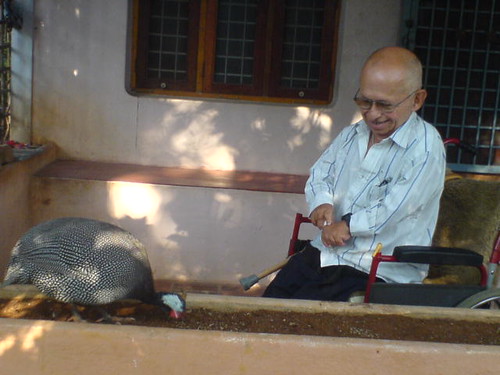
It was over three years ago that a man arrived on my doorstep; in his hand was an ordinary shopping bag which he held away from me slightly, asking if I'd like to see what was inside. The bag heaved slightly, and I couldn't wait. I plunged my hands in to feel a ball of warm featheriness, and ever so gently lifted it out to see a guinea fowl whose beady eyes blinked in the bright light. So arrived Johnnie, a bird who was to be my pride and joy, keeping me company and strutting round the grounds to inspect everything and everybody.
Johnnie pecks for worms in an empty flower-bed
 Not only does he pick up worms, bugs and centipedes, but they say that he can pick pests and parasites off cattle too. He's very green, and a scrupulous biological control officer. There ain't no flies or fleas on him!

Clean as a Whistle

When you make a dive for Johnnie, he just crouches down on the ground, with a crooning noise ~ but only if you're human. If another animal tries to get near him, Johnny is off like a little rocket!

Within a few days of being birthed from his hand-bag womb, Johnnie has made himself completely at home. In fact, Johnnie treats the place as if he's lived here for ever.
And even longer than that.

No unauthorized entry allowed!
When it comes to John's bath, the team of appointed bathers move in to do their duty. Bathing is a great daily event here, and  for maximum satisfaction for all, it's carried out in a small enclosure at the rear of the house.

For some it's a pleasure, for some it's a chore; some just want to get on with their study jobs and not spend an hour being swallowed up by the bathing and exercising ritual, but for Johnnie this event carried out at 10.00 a.m. each morning is an important job and a positive delight.


Just the Thing to Wet My Whistle
The special treat is, for some reason, my dirty bath-water. This would doubtless raise some eyebrows, were it to be witnessed in the outer and greater world. But Johnnie is crazy about sipping it while it's still warm, and I maintain that there are some vital micronutrients and trace elements which Johnnie finds beneficial to his health.

This is a Good as it Gets
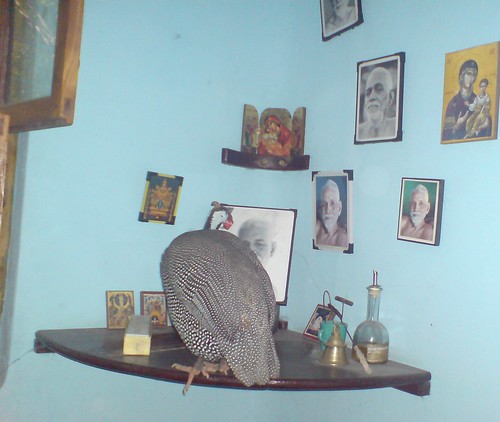
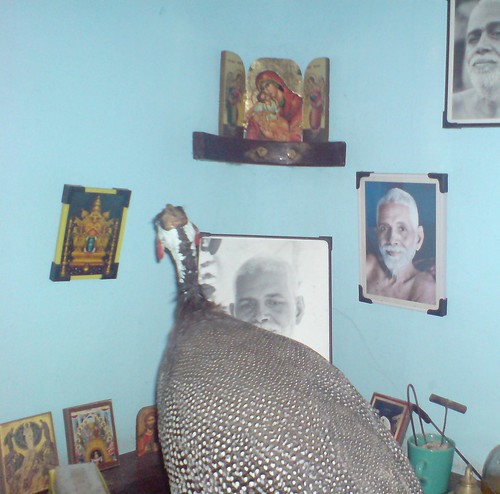
After the ritual of bathing, it's time to spend in quiet refection as we offer our devotions foe the day. Not to be left out, Johnnie is very methodical in his duties as a verger, and he pays his earnest respects to the many names and forms we give to the One Creator and the the source of all life and being:
Hail Ramana!
Hail Mary!
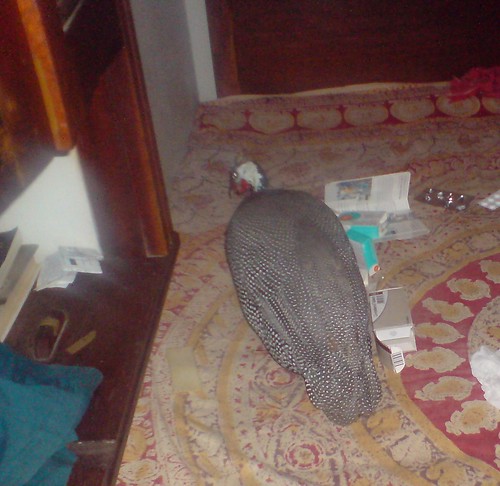
     A few days before we leave India, Johnnie becomes fully involved in the packing:
                                                     
Better sure they don't leave something important behind!
Master has packed all the Important Tablets.
Hope he takes Good Care while he's in England
 Good-bye dear Johnnie, you valiant wee policeman of a bird; I guess you're past middle age for a guinea fowl by now, and you must take good care of your health!
     Regulating his life according to a strict and fastidious routine, Johnnie goes off duty when the shadows of night begin to fall. Ensuring that he hasn't left any loose ends behind, he heads for his favourite tall tree, where he flies aloft to perch on his favourite branch, away from night predators and snakes.

~   ~   ~   ~   ~   ~   ~   ~   ~   ~
Johnnie has left us now. Gone to meet his maker, as it were: Yesterday while quietly feeding, he was set upon by a gang of five hungry dogs, who attacked and him before tearing him to pieces and eating him up. It feels indescribably sad, that a quiet, peaceful and devoted being should meet his end in this violent way.

Good-bye, dear brave friend: For more than three year you shared our lives and our houses. I hope your end was quick and that it didn't hurt too much. 

Wednesday, July 21, 2010

What did the Lady Really See?

As a child, I saw a program on the telly where a tasty meal was prepared and served upon a plate; the food then was held out toward the viewer offering you the chance of taking it out of the telly and enjoying it. From that time onwards, I’d held a hidden wish that one day someone would buy me a TV like that. Or at least if it wasn’t to do with cooking, I wished that the day might dawn on which a TV story would spill itself out of its electronic box and so come into my life. What I didn't expect was that the time would arrive when this would happen to me, when I was at the tender and highly impressionable age of thirty-five.

It was the mid 1980's, and after a sorry gap of one-and-a-half decades I found myself back in India, having fed on and swallowed the Mahatma Gandhi line with no thought as to how I’d digest the fish that he’d left wriggling on the hook. Caste distinction had gone, and brahmin and road-sweeper could now walk together in the garden of frangipani trees, even if they weren't yet ready to clasp hands or at least link their arms together.

I was staying in Madras (as it was then) as the guest of a merchant I'd met on my first visit, and for a few nights I was to be their guest before moving on into the deeper south. They now had a colour TV and an A/C living room with sofa, and they appeared anxious for me to watch the movie which had just started and, although part of my reason for coming to India was to get away from the telly, I felt unable to move off to the shady garden with a book. A guest was staying with them, a lady with a silent green silk sari who made a waft of scented wind in my direction as she swept by, for she wore fresh jasmine flowers tied into her hair. She was coming from the direction of my hostess's kitchen, bearing a small dish of ice-cubes, on the top of which were set four dark sweetmeats. I immediately recognised them as the Ferrero Rocher chocolates which I'd brought from England as a gift for my hostess. The Green Lady immediately opened the gold foil wrapping and popped one into her mouth, before sitting squarely on my right as she settled her ample bottom down on the settee like a mother hen on a clutch of eggs.

DSC00005cropped
The film related the story of a love affair between a high-caste brahmin lady and a young man from one of the lower castes. Degree by degree the pair were fighting social prejudice and bigotry, their few triumphs and many set-backs musically unfolding in front of us. The vision in cool green had become so transfixed with the proceedings, that she'd returned to the 'fridge to get a few more of the diminishing supply of chocolates, and had even managed to replace the ice. Returning with her replenished dish, she gave me a little grin as she immersed herself in the story, saying: “I expect you're thoroughly sick of these, but for us in India they are a great treat! Mmmm” As I watched her sucking the dark cluster into her orifice, my glance flicked over to the left to where my new friend and object of adoration, Chandru, was standing in the shadow near the screen. Chandru my carer of a few weeks’ standing, was lurking with the look of I-don’t-belong-in-there on his face; Chandru, whose skin was the same colour as the chocolates which the Green Lady was devouring with relish.

In a flash I saw it all: India’s heart had long been torn by class division: when the mad slash of zealotry had taken his life away, Mahatma Gandhi had left his healing message for the Nation ~ the message that untouchability was a sin and a crime. Little by little the message had filtered down to everyone and now this middle-class home, this fan-cooled living room had become a melting pot for that message for me — on my right side the Green Goddess was munching away, and on my left was a young man from the caste of thr lower scribes, who had worked his way into the job of caring for me and had also seated himself in my heart. What more natural than for him to come to sit next to me on the same sofa as the Green Lady, watching a hopeless love affair on the TV, yet knowing that within this very room, racial prejudice was melting as fast as the ice-cubes in the lady’s saucer?

A vision welled up in me, a picture of harmony and peace, goodwill to all men. This very room was to be the melting pot, the microscopic picture of bonhomie which would radiate steadily outwards until it engulfed all of the sub-continent: after all, the ingredients were here, instigated by the very programme we were watching. It had reached the point where the lovers from different castes were being torn apart by family and social prejudices. It was very heart-rending too. The Green Silken lady took the corner of her sari with her left hand and wiped away a tear which had started to run down her cheek, whilst with her right hand she took another chocolate from its bed of ice and crunched noisily. That particular hazelnut must have been a hard one, for I fancied it had put up a valiant fight before getting crushed between her molars.
DSC00004

What was I waiting for? There ahead of me was the film, on my right hand was the lady, on the left my shadow-lurking lower-caste friend. Why not call him over to join us and we could all wallow together and end up being friends? Didn’t revolutions begin in the most unlikely of places, and hadn’t I read once that the Indian Mutiny been sparked off by a chapatti? What, in effect, was preventing me from calling him over? Only my own stupid self, I decided. I myself, who could soon be sitting alongside the very Indian waiting in the wings, I could be the spark that starts off a social revolution, if only I could conquer my own inbuilt sense of hesitation; besides, I knew already that these chocolates were a rich source of the euphoric drug theobromine, which was why one gave them as a token of love, didn't one? Deciding that my fears were groundless and that this was, after all, 1985, I patted the seat next to me with my hand and called him to come to sit by me, while making reassuring noises that there was no reason whatever to be afraid.

DSC00020DSC00018Chandru came over and sat beside me cautiously as he took my hand. The woman on the right sharpened her face so that her nose appeared much more angular than it was made to be, and the muscles in her body seemed generally to tighten up; she took one of the two remaining sweets off the melting ice and pushed it in her mouth, not with the lazy relaxed swing of a few moments early, but with an impulsive motion that was almost a twitch. “Oh of course,” she said, “I see he needs to come and help you back a bit” and stupidly I fell in with idea, with Chandru easing me back another inch or two onto the settee; but he carried on holding my hand after I’d become settled. The lady on my right began unwrapping the last clustered chocolate from its melting dish of ice and carried on watching the movie, which was now approaching its melodramatic climax, with plenty of tears and pleadings and tugging at the hamstrings of the heart. Chandru was holding my left hand firmly in his right, and I saw my short stubby white fingers poking out between his long and slender black ones. I looked down with a pang of shame, for I would have wished that mine were as long and graceful and delicately formed as his. He however did not seem to mind or even see the clash of what my eyes saw, for I think he felt another tension hitherto unknown to me. His hand-grip tightened, [DCS00020] but his entire body grew more fidgety, and he said: “Shall I get your bed ready for you to take some rest, dear? You have had a long journey of many kilometres and you should take some rest.”

My enthusiasm of a few moments ago evaporated, and I knew that with Chandru’s announcements, the magic of the dream was melting fast. I was aware of kitchen noises and cupboards being noisily closed. What sounded like a ’fridge door followed by a mallet sound. Soon after this, Milli the daughter of my friend entered with a beaming face and a dish of crushed ice fragments on which were borne more Hazelnut Chocolate Clusters. She looked sorrowfully at the green lady’s pool of water with its fast disappearing lumps and its twisted strands of golden silver paper. “How are you Chandru?” she said smiling. Scanned at [7-15-2010 16-09 PM (5)] “Heavens, look at the time! Night falls so fast in the tropics, and we fear your auntie will be worrying about where you have got to and believe me, you don’t want your bus to become bogged down in the traffic. This is Madras, not a country town you know!”  
Scanned at 7-15-2010 16-09 PM (5)
Chandru’s twitching nerves now had an outlet, and he sprang up as if propelled on a spring. With a hurried thank you, and words of how much he had enjoyed the film, he jerked his limbs in several directions, and picked up his little overnight bag; he mumbled a hurried good-bye to me, and within a few moments he had left. Milli came over and sat next to me, offering me a Ferrero Rocher from its crushed ice-bed. I thanked her, but reminded her that they were a gift, and in England I could get them any time I wanted.

I stared vacantly at the TV and reflected that in distant childhood I'd been watching it and wishing that the magic drama being enacted on the box would spill out into living room. Now it had done that with the granting of my wish. This was my reintroduction to the new India, and I wondered whether I'd be ale to swim the waves without becoming engulfed by them. We all had seen different pictures, different movies, and my attempt to harmonise them marked the beginning of a struggle that was to puzzle me for many years.